LONG TRADITION OF HONORING THE SAUK AND MESKWAKI NATIONS
Families and travelers exploring the Midwest’s Black Hawk War of 1832, the final conflict against Native Americans east of the Mississippi River, will find the Quad Cities as a keystone destination.
The confluence of the Rock and Mississippi Rivers served the Meskwaki (Fox) and Sauk nation for generations. Where the Quad Cities is today, was home to thriving Native American communities including the Sauk city of Saukenuk which may have had a population of four to six thousand in the late 1700’s.
A series of treaties forced the Native American’s out of the region. The last armed conflict occurred in 1832 when American forces confronted Black Hawk (read his autobiography) and his “British Band” of approximately 1,200 followers. Named in honor Black Hawk’s allegiance to his former British allies, whom he fought alongside during the War of 1812, the “British Band” hoped to bargain for concessions and a return of the land and fertile soil they had long nurtured. During the summer of 1832, American troops and the Illinois militia (which for a few weeks included a young Abraham Lincoln) chased down and eventually defeated the British Band at the Massacre at Bad Axe near Desoto, Wisconsin.
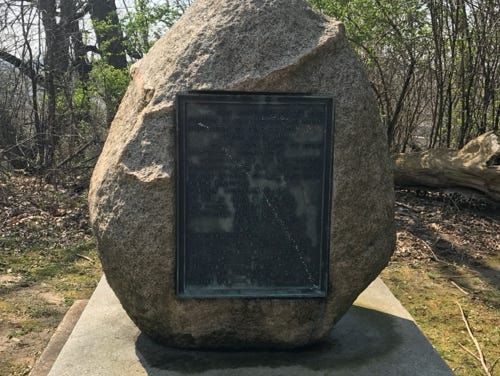
While early American settlers displaced the original First Nation communities, the Quad Cities have worked diligently to highlight and honor the Sauk and Meskwaki Nations. The first memorial in the country to honor Black Hawk was erected in 1892. At the time, the Rock Island Argus newspaper reported on the festivities of its unveiling, including Bleuer’s band performing “patriotic airs” along with a pyrotechnic exhibit. It was hoped that the statue would be erected close to the corner of Twelfth and Ninth Streets, which, according to local tradition was the center of Saukenuk. Donated by O.J. Dimmick, the statue was moved to the Black Hawk State Historic Site and the Hauberg Museum, from its original home in Spencer Square. The scenic peak in Black Hawk State Park, or Black Hawk’s Watchtower (detailed history of the site written by Hauberg in 1927), has long been a popular site for hiking and viewing wildlife.
This statue also was the image that renowned American muralist, Richard Haas, used for his colossal mural of Black Hawk just a few minutes away at 1701 2nd Avenue, Rock Island, IL. His first mural that incorporated a smaller image of Black Hawk was completed in Madison, Wisconsin. Unfortunately, that mural is now obscured by a convention center.
John Hauberg (1869–1955), the noted Rock Island philanthropist, was a passionate advocate in preserving and spreading the legacy of First Nations in Illinois. Over decades he befriended members of the Sauk and Meskwaki Nations (today in Iowa, Oklahoma and Kansas) and built a collection of artifacts and documents that are now housed in the Hauberg Indian Museum within Black Hawk State Park. In 1940, the Meskawki Nation near Tama, Iowa, honored John Hauberg with a traditional dance in Rock Island that included bestowing a tribal name upon Mr. Hauberg.
Additional nearby historic sites include the Rock Island Arsenal Museum and Colonel Davenport House. The partial reconstruction of Fort Armstrong (freely accessible) is another notable site that played a role in the important story of the Black Hawk War.
Boarding the nearby Celebration Belle in Moline for a river excursion is an excellent option to experience the beauty of the area that was contested during the conflict. Tours include longer trips that allow for journeys north to Prairie du Chien and Dubuque.
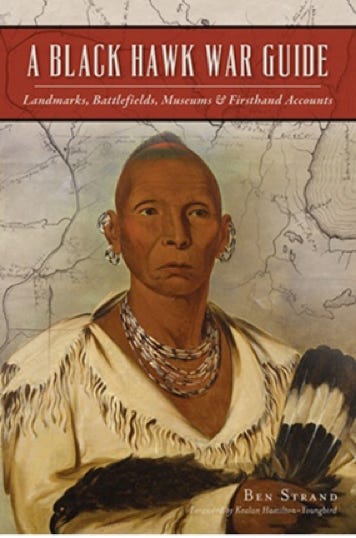
By Ben Strand; parts of this article reprinted from his book A Black Hawk War Guide: Landmarks, Battlefields, Museums & Firsthand Accounts (The History Press, 2021).
Ben Strand hails from the Uplands of southwestern Wisconsin. With degrees from the University of Wisconsin and an MFA from Goddard College in Vermont, he currently makes his home in the Driftless region of Wisconsin.